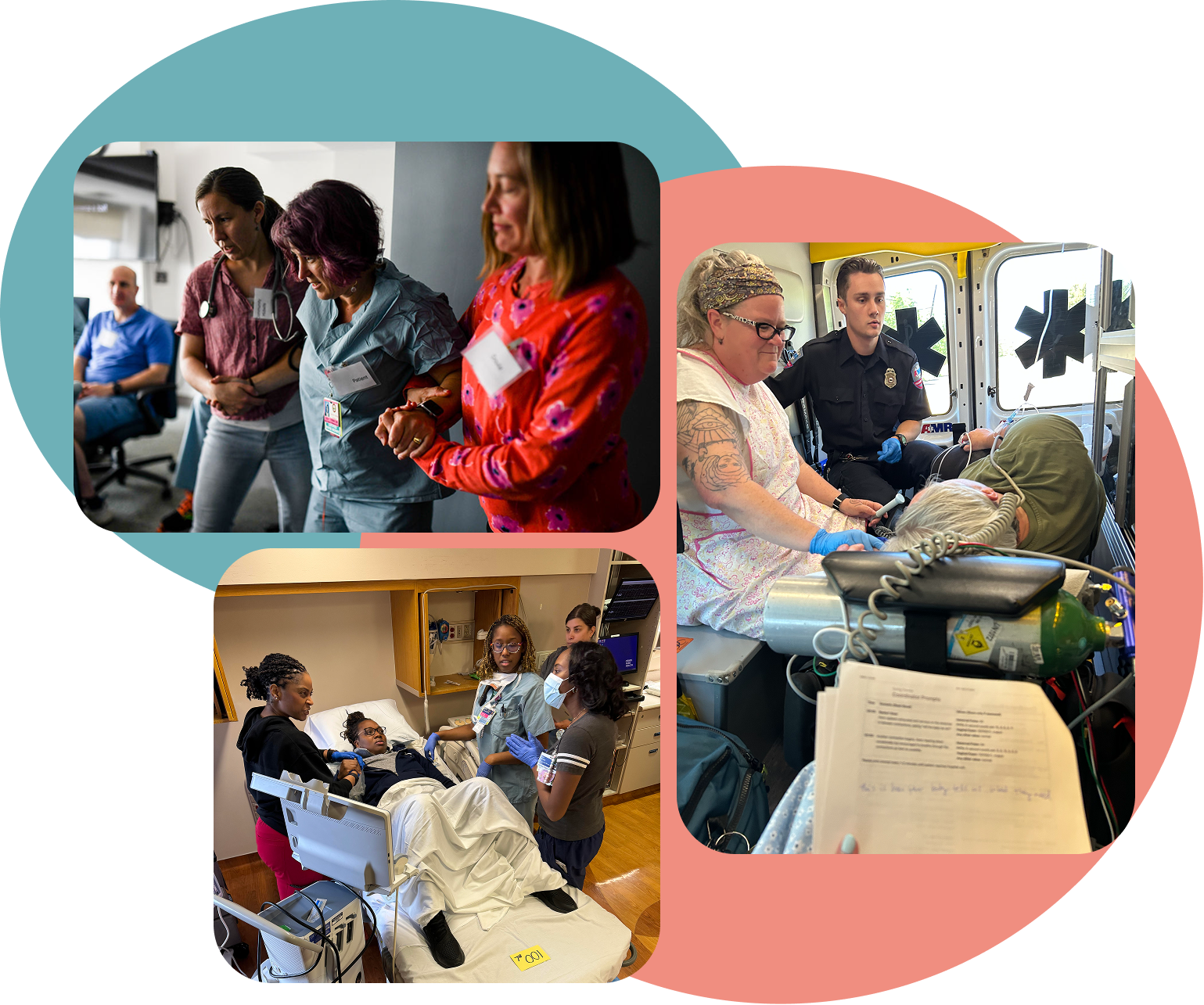
Local Teams, Statewide Partnerships: Meet the 2026–2027 Step Up Together Action Collaborative
This fall, we welcomed 23 teams to the 2026–2027 Step Up Together Action Collaborative, bringing together community midwives, hospitals, emergency medical services (EMS), and quality improvement partners to strengthen transfers from community birth settings to hospitals.
Our two cohorts—one focused on birth center transfers and the other on home birth transfers—represent a remarkable range of communities and maternity care systems. Participating teams include practices serving remote rural areas, growing suburban communities, and major cities including Boston, Las Vegas, and Washington, DC.
Despite their different settings, these teams share a commitment to making transfers safer, more coordinated, and more respectful for patients and families.
By the Numbers
23
Participating Teams
13
states, plus Washington, DC represented
5
states connecting their participation to perinatal quality collaboratives or other statewide quality improvement efforts: California, Iowa, Ohio, Utah, and Wisconsin.
14 / 23
applicants had already identified an EMS partner ready to participate in a transfer drill when they applied
Different communities, different challenges
The diversity of participating teams is especially apparent in rural communities, where access to maternity care is increasingly fragile.
Two participating birth centers are working with emergency departments at local Critical Access Hospitals that no longer have labor and delivery units. For these teams, effective emergency transfer processes are an essential part of maintaining access to community-based maternity care.
As one team explained in its application:
"We believe the challenges facing rural maternity care require innovative approaches and a willingness to rethink traditional models of care."
At the same time, teams in larger cities are navigating different challenges, including complex hospital systems, busy EMS services, and longstanding barriers between community birth and hospital-based care. One participating team in a major metropolitan area already conducts simulation drills with EMS and regularly reviews transfers with its hospital partner. But the team has never tested the entire transfer process together. As they explained in their application:
We want to move beyond individual-site drills to identify gaps and strengthen the complete transfer pathway together.
What motivated teams to join?
The applications reflect both the challenges teams face and their ambitions for improving care.
For some, the priority is addressing difficult experiences during transfers. One home birth practice described problems with communication and treatment of both midwives and patients, and hopes to use the Collaborative to establish stronger transfer processes and renew conversations with local hospitals.
Others are focused on establishing good systems from the beginning. An urban birth center preparing to open and sees the Collaborative as an opportunity to build strong partnerships and transfer processes as it moves toward implementation.
And some teams are looking for ways to build on relationships that are already working well. One established team shared:
"We believe the next step is to deepen those relationships through regular, structured simulation and team-based learning."
These perspectives illustrate why we designed the Action Collaborative around local teams rather than a single prescribed approach. Each team brings its own relationships, challenges, and opportunities for improvement.
Five states connecting local teams to statewide improvement
Another exciting development this year is the involvement of perinatal quality collaboratives and other state-level quality improvement organizations.
In California, Iowa, Ohio, Utah, and Wisconsin, participating teams are connecting their local transfer improvement work to broader efforts to strengthen maternity care coordination.
Some states have multiple teams participating together, while others are building on previous transfer drills and ongoing partnerships.
These connections create opportunities for teams to share what they learn, identify challenges that extend beyond individual communities, and develop approaches that other maternity care teams in their states may be able to adopt.
The Work Ahead
Over the coming months, each team will plan and conduct a Full Transfer Drill. Using Step Up Together's ready-to-use Drill Kits, teams will simulate the entire transfer process, from the decision to transfer through EMS response, transport, and hospital handoff.
The Action Collaborative provides tools, coaching, and community to support teams throughout this process. Through group learning sessions and individualized coaching, participants will learn to facilitate and debrief interdisciplinary drills, identify opportunities for improvement, and test practical changes to strengthen their local transfer systems.
Teams will also learn from one another, sharing their experiences, challenges, and solutions across different maternity care settings. This peer learning is especially valuable as teams work to build lasting relationships and sustain improvements beyond a single drill.
We're excited about the range of perspectives represented in this year's cohorts, and especially about the opportunity to connect local improvement efforts with broader statewide quality improvement initiatives.
We look forward to sharing what these 23 teams learn over the coming year—and to seeing how their work strengthens maternity care systems in communities across the country.
Interested in being a part of an upcoming Action Collaborative?